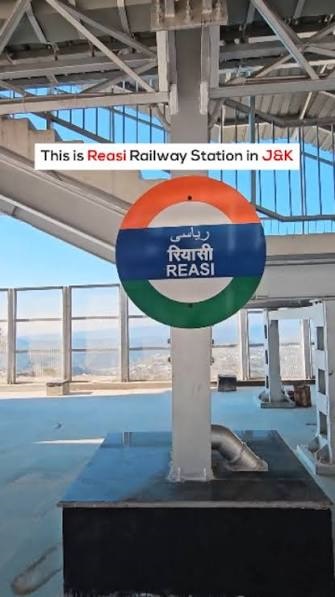
Jammu–Reasi–Poonch Rail Line Moves Ahead With Final Survey; Jammu–Katra Gets Additional Line Push
By: News Desk | 07 Aug 2026
A new chapter is taking shape in Jammu and Kashmir’s railway expansion, with two important connectivity proposals moving through the planning process.
The Reasi–Poonch railway line has received approval for a Final Location Survey (FLS), a crucial technical step towards determining whether and how the proposed line can be built. Separately, Indian Railways had already sanctioned a Final Location Survey for an additional Jammu–Katra railway line, aimed at increasing capacity on one of Jammu’s busiest pilgrimage corridors.
Together, the two developments point towards a broader effort to strengthen rail infrastructure beyond the existing network and extend its benefits to areas where road transport remains the dominant mode.
But there is an important distinction: a Final Location Survey is not the same as construction approval.
The survey must establish the technically feasible alignment, geological conditions, engineering requirements, traffic potential and indicative project cost before the project can proceed through subsequent approval stages.
For Jammu and Kashmir, however, the significance is considerable.
The Reasi–Poonch proposal could bring rail connectivity closer to the Pir Panjal and border belt, while the additional Jammu–Katra line could provide extra capacity on a route carrying large numbers of passengers, particularly pilgrims travelling to Shri Mata Vaishno Devi shrine.
Reasi–Poonch Railway Line: 190-Km Survey Sanctioned
The most recent development concerns the proposed Reasi–Poonch railway line.
The Ministry of Railways approved the Final Location Survey in April 2026. According to the Railway Board communication, Northern Railway has been authorised to undertake the survey for a proposed route of approximately 190 kilometres, with an estimated survey cost of ₹26.41 crore.
The approval followed a proposal submitted by Northern Railway in December 2025.
The proposed alignment is particularly significant because Reasi already forms an important part of the Udhampur–Srinagar–Baramulla Rail Link (USBRL). The USBRL, extending 272 km, has connected the Kashmir Valley with the broader Indian railway network and includes major engineering achievements in the Reasi region.
A future Reasi–Poonch link could therefore potentially extend the reach of this railway infrastructure deeper into the Pir Panjal region.
Why Reasi Is the Strategic Starting Point
The choice of Reasi as the starting point has an important infrastructure logic.
Reasi is already connected to the national railway network through the USBRL. Moving a proposed line towards Poonch could create a new rail corridor for an area that has historically relied heavily on roads.
The terrain, however, will make the project considerably more challenging than a conventional plain-area railway.
The route would have to negotiate steep mountain slopes, valleys, unstable geological formations and areas vulnerable to landslides and other natural hazards.
That means the FLS is not merely a formality.
It will be an important exercise in determining whether the proposed corridor can be engineered safely and economically.
What Does a Final Location Survey Actually Do?
For readers unfamiliar with railway planning, the Final Location Survey is one of the most important stages before a major railway project moves towards construction.
The survey examines several factors, including:
- The most suitable railway alignment
- Terrain and geological conditions
- Tunnel requirements
- Bridge locations
- River and stream crossings
- Land requirements
- Environmental considerations
- Traffic and passenger potential
- Construction feasibility
- Estimated project cost
- Engineering and safety requirements
In the case of Reasi–Poonch, the Railway Board’s approval specifically places the survey under Northern Railway.
A subsequent tender also sought work involving geological studies, traffic surveys, techno-economic studies, railway alignment design and preparation of a Detailed Project Report (DPR) for the proposed line.
This makes clear that the current exercise is intended to establish the technical and economic foundation for any future construction decision.
Reasi–Poonch Rail Link Could Change the Pir Panjal Connectivity Map
If eventually approved and constructed, the railway line could have an impact well beyond passenger travel.
Poonch and Rajouri are strategically important border districts, while large parts of the region have difficult mountainous terrain.
Better railway connectivity could potentially improve the movement of passengers and goods, reduce dependence on long road journeys and improve access to markets and services.
For tourism, the impact could also be significant.
The Pir Panjal region has considerable natural and cultural tourism potential, but road accessibility and travel time remain important factors influencing visitor movement.
A reliable rail connection to the wider national network could encourage more visitors to explore destinations beyond Jammu city and the established Kashmir Valley circuit.
However, these are potential benefits, not immediate outcomes. They would materialise only if the survey establishes technical feasibility, the project receives all required approvals, funding is sanctioned and construction is completed.
The Rajouri–Poonch Question: Why the New Alignment Matters
The latest proposal also needs to be viewed against the history of railway planning for the region.
A previous survey examined a roughly 223-km Jammu–Poonch line via Akhnoor and Rajouri. According to information cited in local reporting, the earlier proposal had a high estimated project cost and low traffic projections, factors that affected its feasibility.
The Reasi–Poonch proposal represents a different approach.
Rather than starting from Jammu and following the earlier route through Akhnoor and Rajouri, the proposed line would begin from Reasi, which is now connected to the USBRL system.
That makes the current FLS particularly important.
It will determine whether the new alignment offers a more practical technical and economic solution.
Jammu–Katra Additional Railway Line: Why It Matters
The second major development concerns the Jammu–Katra railway corridor.
Indian Railways sanctioned the Final Location Survey for an additional new line between Jammu and Shri Mata Vaishno Devi Katra in July 2025.
The proposed additional line covers approximately 77.96 km, with the survey sanctioned at an estimated cost of ₹12.59 crore. Northern Railway was designated to undertake the survey.
This proposal is driven by a very different requirement from the Reasi–Poonch project.
Here, the central issue is capacity.
Jammu is one of the principal gateways for pilgrims travelling to the Shri Mata Vaishno Devi shrine at Katra. The route also serves regular passengers and visitors travelling towards the Reasi region and beyond.
An additional railway line could provide greater operational flexibility and help reduce pressure on the existing corridor.
Why Jammu–Katra Needs More Railway Capacity
The Jammu–Katra route experiences significant passenger demand, particularly during pilgrimage seasons.
When passenger traffic rises sharply, railway operations become more complicated on a single-track section.
Trains travelling in opposite directions may require operational regulation, while special services can place additional pressure on available capacity.
An additional line could help railways schedule more services and manage traffic more efficiently.
For passengers, the potential benefits include:
- More train services
- Better timetable flexibility
- Reduced operational conflicts
- Improved handling of peak-season traffic
- Greater resilience during disruptions
- More comfortable pilgrimage travel
The July 2025 survey sanction was explicitly presented as a step towards strengthening connectivity to the Vaishno Devi pilgrimage destination and supporting tourism and regional economic activity.
Two Projects, Two Different Railway Needs
Although the Reasi–Poonch and Jammu–Katra proposals are geographically connected to the broader Jammu region, they address different infrastructure problems.
| Project | Current Status | Main Objective | Potential Benefit |
|---|---|---|---|
| Reasi–Poonch | FLS sanctioned in April 2026 | Explore new rail connectivity | Border-area access, tourism, trade and regional development |
| Jammu–Katra Additional Line | FLS sanctioned in July 2025 | Add capacity | Better passenger movement and pilgrimage connectivity |
The distinction is important.
The Reasi–Poonch project is primarily about expanding the railway network into a relatively underserved mountainous and border region.
The additional Jammu–Katra line is primarily about augmenting capacity on an already important railway corridor.
Together, they represent two sides of infrastructure planning: reaching new areas while strengthening existing high-demand routes.
Defence and Strategic Importance
The Reasi–Poonch proposal also carries strategic significance because of the geography of the region.
Poonch and Rajouri are located close to the Line of Control and have long been strategically important.
A railway connection could eventually provide an additional mode of transportation for personnel, equipment and supplies.
However, claims about specific defence logistics benefits should be treated as potential strategic advantages rather than confirmed operational plans unless the Ministry of Defence or Railways formally specifies them.
The broader principle is clear: better transport infrastructure in border areas can strengthen logistical resilience.
Roads will remain essential in mountainous regions, but an additional rail corridor could provide redundancy and another transport option.
The Biggest Challenge: Building Railways Through the Mountains
The biggest obstacle will not be the announcement.
It will be the terrain.
Jammu and Kashmir’s mountainous landscape can dramatically increase railway construction costs and complexity.
A railway through the Pir Panjal region may require extensive tunnelling, bridges, viaducts, retaining structures and slope stabilisation.
Geological conditions also vary considerably over short distances.
A tunnel alignment that appears feasible on preliminary maps may encounter difficult rock formations, groundwater, fault zones or unstable slopes during detailed investigation.
That is why the geological component of the FLS and DPR will be crucial.
Landslides and Extreme Weather
The region’s exposure to heavy rainfall, landslides and slope instability adds another layer of engineering risk.
Recent incidents of ground subsidence and infrastructure damage in parts of the Jammu region have again highlighted the need for careful geological assessment before major construction.
For a railway project intended to operate for decades, climate resilience must be built into the design rather than added later.
Drainage, slope protection, tunnel safety, emergency access and monitoring systems will all become important considerations.
Cost Could Become the Defining Issue
The survey cost and eventual construction cost are two very different figures.
The ₹26.41 crore approved for the Reasi–Poonch FLS is the cost of investigating and designing the proposed corridor—not the cost of building the railway itself.
The eventual construction bill could be many times higher because of tunnels, bridges, land acquisition, stations, electrification, signalling and other infrastructure.
This is where the Detailed Project Report will become decisive.
Railway projects are generally assessed on multiple parameters, including traffic potential, economic and social benefits, connectivity requirements and strategic considerations.
The government has also previously clarified that after a DPR is prepared, project sanction requires consultations and approvals involving multiple stakeholders and institutions, and therefore exact construction timelines cannot automatically be fixed at the survey stage.
Survey Approval Does Not Mean Construction Starts Tomorrow
This is perhaps the most important point for residents of Reasi, Rajouri and Poonch.
A Final Location Survey is a major planning milestone, but it is not construction approval.
The broad sequence is likely to involve:
Final Location Survey → Geological & Traffic Studies → Alignment Finalisation → DPR → Appraisal/Consultation → Project Sanction → Funding → Land Acquisition & Clearances → Tendering → Construction
Each stage can take considerable time, particularly for a large mountain railway.
Therefore, it would be premature to announce a firm completion date for the Reasi–Poonch line at this stage.
Economic Impact Could Extend Beyond Railway Stations
If the Reasi–Poonch project eventually becomes a reality, its economic impact could spread well beyond the railway stations themselves.
Improved connectivity can reduce travel friction for businesses, improve access to markets and encourage investment around transport nodes.
Small businesses could benefit from increased passenger movement.
Tourism operators could develop new circuits.
Agricultural and local products could potentially gain better access to larger markets.
Construction itself would also generate employment and demand for local services, although the scale and duration would depend on the eventual project design.
The same logic applies to the Jammu–Katra additional line.
More railway capacity could strengthen pilgrimage tourism while reducing pressure on road transport during peak periods.
A Larger Railway Transformation Is Already Underway
These developments should also be seen against the transformation brought by the Udhampur–Srinagar–Baramulla Rail Link.
The 272-km USBRL has been commissioned and connects major parts of the Jammu and Kashmir railway system, including Reasi and the Kashmir Valley. The project involved major tunnels, bridges and approach infrastructure and has already generated significant employment and connectivity benefits.
The next phase of railway development is therefore less about simply bringing trains to Jammu and more about building a connected regional network.
Reasi–Poonch could extend that network towards the Pir Panjal and border belt.
Additional capacity between Jammu and Katra could strengthen the southern gateway to the existing network.
Other proposed railway initiatives, including routes towards border and tourist areas, could eventually create an even more integrated system if they clear the necessary feasibility and approval stages.
What Happens Next?
For the Reasi–Poonch line, the immediate priority is the completion of the Final Location Survey and associated technical studies.
The survey will have to answer some fundamental questions:
Where should the railway run?
How many tunnels and bridges will be required?
What geological risks exist?
What will the project cost?
How much passenger and freight traffic can reasonably be expected?
What stations and facilities will be required?
Can the project be justified economically and strategically?
The answers will determine whether the proposal advances to the next stage.
For Jammu–Katra, the focus remains on taking forward the additional-line planning process and determining the most effective alignment and engineering solution for increasing capacity.
Jammu & Kashmir’s Railway Future: From Connectivity to Integration
For decades, railway connectivity in Jammu and Kashmir was largely concentrated around the Jammu region, while the mountainous districts remained dependent on roads.
The USBRL has changed that geography.
The proposed Reasi–Poonch line could potentially take the next step by bringing rail closer to communities in the Pir Panjal and border areas.
The additional Jammu–Katra line addresses another challenge: ensuring that an increasingly important railway corridor has enough capacity to handle future demand.
But expectations must remain realistic.
The sanction of a survey is not the arrival of a train.
It is the beginning of the engineering, economic and administrative process that could eventually make that train possible.
For Reasi, Rajouri and Poonch, however, the April 2026 approval represents a significant milestone. For the Jammu–Katra corridor, the additional-line survey offers a potential answer to growing passenger demand.
If both projects successfully move through their subsequent stages, Jammu and Kashmir could see a railway network that is not merely a route to the Kashmir Valley, but a much broader system connecting pilgrimage centres, border districts, tourism destinations and emerging economic hubs.
That is where the real significance of these railway surveys lies: not simply in laying more tracks, but in reshaping how Jammu and Kashmir connects with itself and with the rest of India.